
Skip to content
OneSuite Logo
  • ProductExpand
    • Client Portal

      Ensure transparency & gain trust

      Invoice

      Create invoices in minutes & get paid

      Project Management

      Manage tasks smartly & deliver timely

      CRM

      Nurture leads and win more clients

      Document & E-Signature

      Create & sign documents easily

      Team & Collaborators

      Work together, stay aligned

      Email Inbox

      Manage client emails in one place

      Time Tracking

      Track hours and boost productivity

      Productized Service

      Package and sell services easily

  • Use CasesExpand
    • Marketing Agency

      Manage campaigns, clients, and billing in one place so you can focus on delivering results.

      SEO Agency

      Track projects, share reports, and invoice clients without juggling five different tools.

      Video Editing

      Streamline approvals, revisions, and payments so you spend more time in the timeline.

      Local SEO

      Organize multi-location clients, automate invoicing, and keep every project on track.

      Photography

      From booking to final delivery, manage your entire client workflow in a single dashboard.

      Event Management

      Coordinate timelines, vendors, and client communications without anything slipping through the cracks.

      Creative Agency

      One workspace for briefs, feedback, and billing so your creative energy stays on the work.

      Consulting

      Proposals, project tracking, and invoicing unified so you look as professional as your advice.

      IT Services

      Manage tickets, retainers, and client portals without duct-taping a dozen SaaS tools together.

  • ResourcesExpand
    • Documentation

      Read guides and help docs

      Affiliate

      Partner and earn together

      Integrations

      Connect tools effortlessly

      Roadmap

      See what’s coming next

      Changelog

      Stay updated with the latest

      Support

      Get help whenever you need it

      Compare

      See how OneSuite stacks up

      Case Study

      Real results, real teams

      FAQ

      Find answers to common questions

  • Pricing
  • For Agency

Start free trial

Help Center

  • Documentation
  • Public Roadmap
  • Book a demo
  • Get Support
OneSuite Logo
intro to onesuite

OneSuite 101

6
  • Introduction to OneSuite
  • Understanding OneSuite’s Structure
  • How Solutions Work Together
  • Navigating OneSuite
  • All OneSuite Capabilities
  • OneSuite Glossary
quick start guide

Quick Start Guide

9
  • Sending Your First Invoice
  • Tracking Your First Hours
  • Setting Up Your Business
  • Adding Your Payment Methods
  • Inviting Team Members
  • Adding Your First Leads
  • Adding Your First Client
  • Giving Your Client Portal Access
  • Sending Your First Proposal

CRM

9
  • Opportunity Automation
  • Customizing Your CRM
  • Customizing Your Opportunities View
  • CRM Overview
  • Adding People
  • Adding Companies
  • Creating Opportunity
  • How Opportunities, Companies, and People Work Together
  • Understanding Pipeline Stages
client

Client Management

6
  • Adding Clients
  • Client Profiles
  • Client Portal Customization 
  • Understanding the Clients Solution
  • The OneSuite Client Portal
  • Video Documentation : Client Management
pm

OneSuite Project Management

12
  • How to Track Project Hours and Costs
  • How to Set Up Project Billing and Budgets
  • Laying the Groundwork: Project Creation in OneSuite
  • Customize the Project Management Module
  • Managing Project Boards in OneSuite
  • Subtask Behavior & Movement Management
  • Custom Categories, Tags, and Labels in Projects
  • Adding Tasks to Boards in OneSuite
  • Custom Fields
  • Task Templates
  • Project Templates
  • Video Documentation : Project Management

Documents

5
  • Overview
  • Creating a Document from Scratch
  • Uploading a PDF Document
  • Sending Documents to Parties to Sign
  • Signing a Document
team

OneSuite's Team Management

4
  • Inviting Collaborators in OneSuite
  • Creating Personalized Departments in OneSuite
  • Managing Team Members in OneSuite
  • Video Documentation : Team Collaboration
Invoices & Payments

Invoices & Payments

9
  • How to Use Retainers
  • How to Record Invoice Payments
  • Access & Navigation
  • Invoice Settings & Customization
  • Create One-time Invoices
  • Creating Recurring Invoices
  • How to set taxes on your invoices
  • How to Add Direct Bank Transfer Instructions to Your Invoices
  • How to Customize Invoice Email Messages

Time Tracking & Timesheets

6
  • Timesheet Preferences
  • Work Types
  • Time Tracking in OneSuite
  • Invoice Generation from Billable Hours
  • Timesheet Management & Approval
  • Time Tracking & Timesheets 

Email Inbox

5
  • Email Inbox Overview
  • Connect Microsoft Outlook
  • Integrate Gmail in OneSuite 
  • Send and Receive Email in OneSuite 
  • Create and Use Email Templates in OneSuite

Calendar View

1
  • Calendar View

Dashboard

7
  • Overview 
  • How to Customize Your Dashboard
  • Client Portal Dashboard 
  • Monitor Documents, Contracts & Marketing Lead Sources
  • CRM, Client & Pipeline Widgets — OneSuite Dashboard Guide
  • Track Tasks, Deadlines & Project Activity in OneSuite
  • Track Revenue Trends, Forecasts & Top Projects in OneSuite

Expenses

2
  • Expense Categories
  • Tracking Expenses

Approvals

2
  • Approval Policy
  • Approving Timesheets and Expenses

Estimates

1
  • Estimates

Reports

2
  • Saving and Scheduling Reports
  • Reports Overview

Integrations

5
  • How to Use Webhooks and API Keys
  • How to Connect Analytics Tools
  • How to Connect Calendar, Files and Meeting Tools
  • How to Connect Accounting and Payment Tools
  • Integrations Overview

Settings & Billing

4
  • Imports, Exports, and Search
  • Managing Your OneSuite Subscription
  • Setting Up Profiles and Permissions
  • Setting Up Your Workspace
View Categories
  • Home
  • Docs
  • Expenses
  • Expense Categories

Expense Categories

Expense categories are the list your team picks from when logging a cost, such as Meals, Travel or Software. Category is a required field on every expense, so you need at least one category before anyone can track spend.

In this guide you’ll learn how to:

  • Create an expense category
  • Set a unit name and unit price for costs claimed per unit
  • Edit, archive, restore and delete categories

Before you start

  • You need access to Settings to add or change categories. The Settings page carries an Admin only badge. People without that access can see the list but cannot change it.
  • Categories are shared by everyone in the business. You set them up once for the whole team.

How to create an expense category

You create a category with New category, either in Settings or on the Expenses page. Both places edit the same list, but their dialogs use slightly different labels.

From Settings:

  1. Click your name at the bottom of the sidebar, then click Settings.
  2. Click Time Tracking, then Expense Categories.
  3. Click New category.
  4. Enter a Name, for example Travel.
  5. Click Create.

From the Expenses page:

  1. Click Expenses in the sidebar.
  2. Click the Categories tab.
  3. Click New category.
  4. Enter a Category name, for example Meals.
  5. Click Save category.

A name is required and can be up to 120 characters.
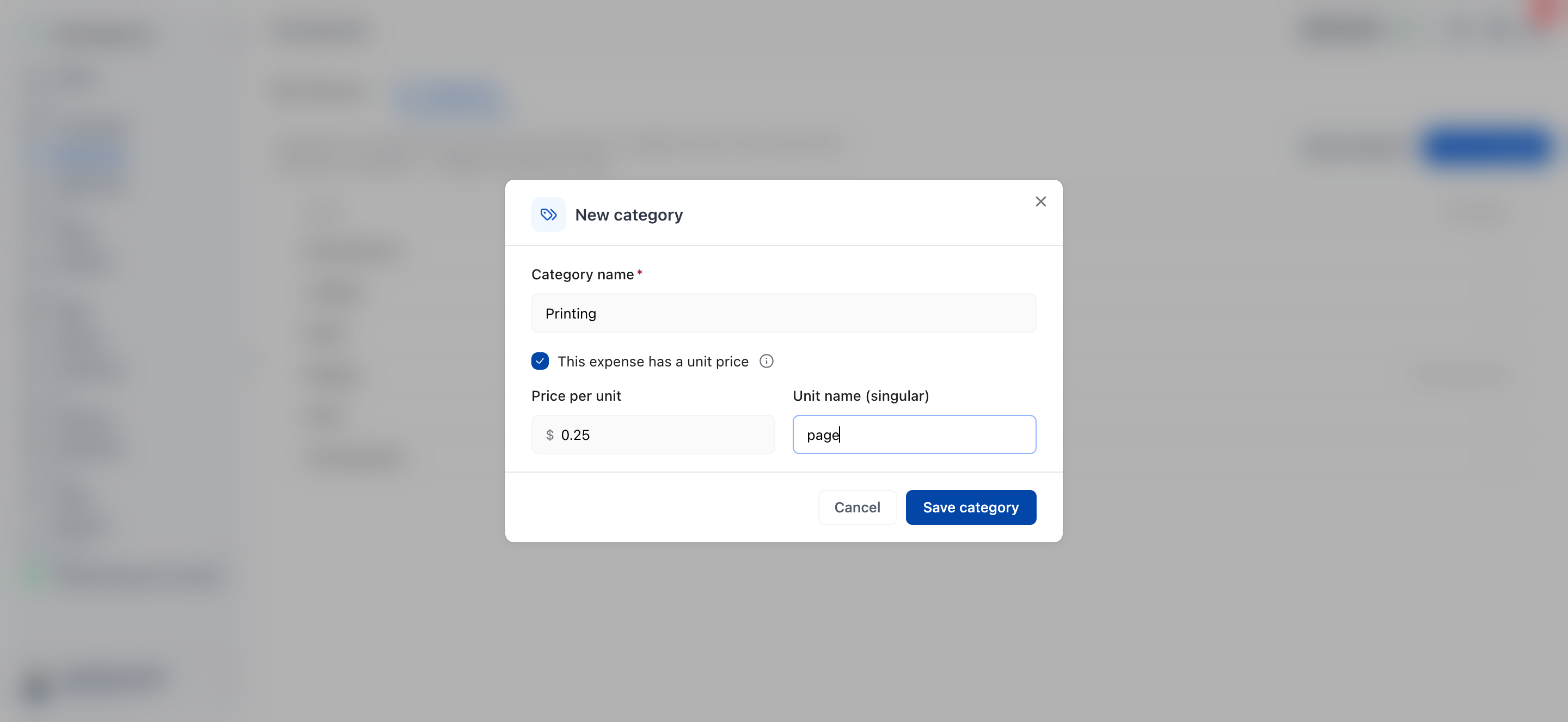
Expenses page, Categories tab, with the New category dialog open and This expense has a unit price ticked

How to set a unit price

A unit price lets your team claim a cost as a quantity, such as miles driven, instead of a cash amount.

From Settings:

  1. Open the category’s actions menu and click Edit, or create a new category.
  2. Enter a Unit name, for example mile.
  3. Enter a Unit price, for example the rate you pay per mile.
  4. Click Save changes, or Create for a new category.

From the Expenses page, Categories tab:

  1. Open the category’s actions menu and click Edit, or click New category.
  2. Tick This expense has a unit price.
  3. Enter a Price per unit.
  4. Enter a Unit name (singular), for example mile.
  5. Click Update category, or Save category for a new category.

From then on, when someone picks this category on an expense, the Amount field becomes Quantity. They enter the number of units and OneSuite works out the total.

A category only switches to quantity entry when it has both a unit name and a unit price. On the Expenses page, unticking This expense has a unit price clears both.

Field Limit
Name or Category name Required. Up to 120 characters.
Unit name Up to 60 characters.
Unit price or Price per unit 0 or more, with at most 3 decimal places, for example 0.535.

How to edit, archive or delete a category

You manage a category from its actions menu, which offers Edit, Archive (or Restore) and Delete.

  1. Go to Settings, Time Tracking, Expense Categories, or to the Categories tab on the Expenses page.
  2. Open the actions menu on the category’s row.
  3. Click Edit to change its name, unit name or unit price.
  4. Click Archive to take it off the picker without losing it.
  5. Click Delete to remove it for good, then confirm.

An archived category disappears from the picker for new expenses and shows Archived in the list. Turn on Show archived to see it, then click Restore to bring it back. Expenses already filed against an archived category keep it, and a unit priced one still asks for a Quantity when you edit the expense.

You can only delete a category that nothing has been tracked against. Otherwise Delete is greyed out with the message Categories with expenses tracked to them cannot be deleted. Archive it instead.

Not using OneSuite yet? Start your free trial →

FAQs

Do I need expense categories before my team can track expenses?

Yes. Category is required on every expense, so with no categories the picker shows No expense categories yet and nobody can save an expense.

How do I set up mileage as an expense category?

Create a category such as Mileage, give it the unit name mile and a unit price per mile. Your team then enters miles driven in Quantity, and OneSuite works out the total.

Why can’t I delete an expense category?

A category that has expenses tracked to it cannot be deleted. Archive it instead: it leaves the picker, and the expenses already filed against it keep their category.

Can I just use Notes instead of categories?

No, not on their own. Notes is free text on each expense, while Category is required and is what gives an expense its unit price. Use both: the category for the kind of cost, the note for the detail.

Who can create expense categories?

People with access to Settings can create, edit, archive and delete categories. Everyone else sees the list on the Categories tab but cannot change it.

What to do next

Start logging costs: Put your new categories to use with Tracking Expenses.

Allow reimbursement: Turn on expense reimbursement in Timesheet Preferences.

Watch project costs: See how expenses add up on a project in How to Track Project Hours and Costs.

Updated on October 1, 2026
OneSuite Logo

Streamline your agency's workflow while you focus on growth—manage clients, projects, teams, proposals, contracts, and invoices effortlessly with OneSuite!

product hunt

Follow Us On

  • Facebook
  • X
  • Instagram
  • LinkedIn

Join Our Community

  • Facebook
  • WhatsApp

Features

Projects

Lead Pipeline

Documents

Invoices

Client Portal

Teams

Resources

Contact

Support

Docs

Blog

Branding

Become an affiliate

Agency Partner Program

Public roadmap

Book a demo

Compare

OneSuite vs. Kitchen Co

OneSuite vs. Moxie

OneSuite vs. Flowlu

OneSuite vs. Plutio

OneSuite vs. Bonsai

OneSuite vs. ClientManager

  • Terms of use
  • Privacy policy
  • Cookie policy
  • Refund policy
  • Acceptable use policy
  • Data processing terms
  • Product
    • Client Portal

      Ensure transparency & gain trust

      Invoice

      Create invoices in minutes & get paid

      Project Management

      Manage tasks smartly & deliver timely

      CRM

      Nurture leads and win more clients

      Document & E-Signature

      Create & sign documents easily

      Team & Collaborators

      Work together, stay aligned

      Email Inbox

      Manage client emails in one place

      Time Tracking

      Track hours and boost productivity

      Productized Service

      Package and sell services easily

  • Use Cases
    • Marketing Agency

      Manage campaigns, clients, and billing in one place so you can focus on delivering results.

      SEO Agency

      Track projects, share reports, and invoice clients without juggling five different tools.

      Video Editing

      Streamline approvals, revisions, and payments so you spend more time in the timeline.

      Local SEO

      Organize multi-location clients, automate invoicing, and keep every project on track.

      Photography

      From booking to final delivery, manage your entire client workflow in a single dashboard.

      Event Management

      Coordinate timelines, vendors, and client communications without anything slipping through the cracks.

      Creative Agency

      One workspace for briefs, feedback, and billing so your creative energy stays on the work.

      Consulting

      Proposals, project tracking, and invoicing unified so you look as professional as your advice.

      IT Services

      Manage tickets, retainers, and client portals without duct-taping a dozen SaaS tools together.

  • Resources
    • Documentation

      Read guides and help docs

      Affiliate

      Partner and earn together

      Integrations

      Connect tools effortlessly

      Roadmap

      See what’s coming next

      Changelog

      Stay updated with the latest

      Support

      Get help whenever you need it

      Compare

      See how OneSuite stacks up

      Case Study

      Real results, real teams

      FAQ

      Find answers to common questions

  • Pricing
  • For Agency
  • Documentation
  • Public Roadmap
  • Book a demo
  • Get Support