
OneSuite’s CRM solution helps you manage your sales process from first contact to closed deal. Track potential business, maintain company and contact records, and move opportunities through your pipeline until they convert into paying clients.
In this guide you’ll learn:
- What the CRM solution does
- The three core record types
- How CRM connects with other solutions
- Where to start when you’re new to CRM
What CRM Does
CRM is where you manage potential business before it becomes actual business. While the Clients solution tracks paying customers, CRM tracks the people and companies you’re pursuing.
Every sales conversation, proposal, and deal you’re working on lives here. When someone becomes a paying customer, you convert them to a client and all their history transfers automatically.
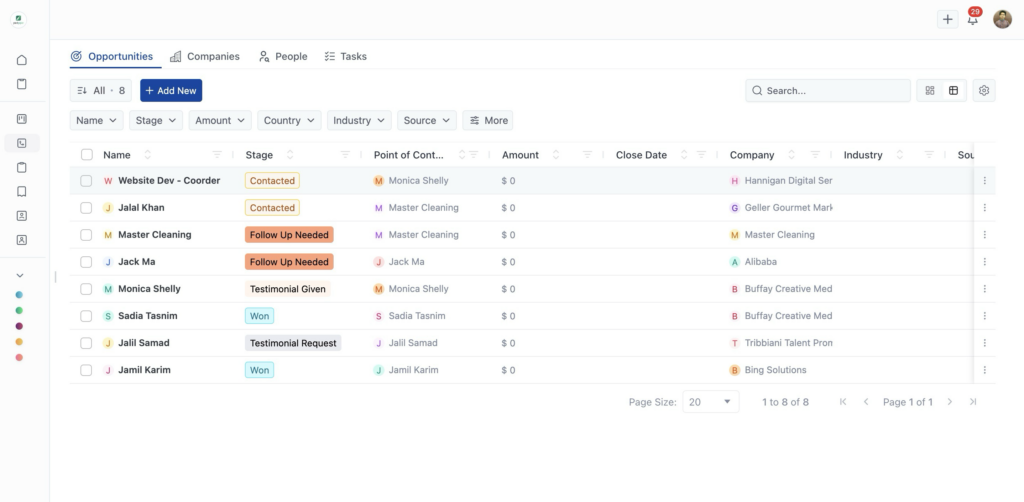
The Three Record Types
CRM organizes your sales data into three types of records that work together:
Opportunities are specific deals you’re pursuing. A website project, retainer contract, or any paid work. Track the amount, stage, and expected close date for each deal.
Companies are organizations you’re working with. Store business details like industry, employee count, and annual revenue. Companies can have multiple people and multiple opportunities.
People are individual contacts. Store their name, job title, email, and phone. People can belong to a company or exist standalone. One person gets designated as point of contact for each opportunity.
These three types link together automatically. Create an opportunity, link it to a company and person, and everything connects. The opportunity knows who it’s for, and those records show the opportunity in their history.
The Four CRM Sections
Open CRM and you’ll see four tabs at the top:
Opportunities – Your active sales pipeline. View deals in visual Kanban board or detailed list format.
Companies – All organizations in your database. List view with sortable columns.
People – Your contact database. Every individual you communicate with.
Tasks – All CRM-related tasks in one place. Filter by what they’re related to.
You’ll spend most of your time in the Opportunities tab managing active deals.
How CRM Connects with Other Solutions
CRM doesn’t work alone. It connects with other OneSuite solutions to eliminate duplicate work:
Proposals & Contracts – Send proposals to opportunities. They link automatically.
Clients – Convert won opportunities to clients with one click. Contact information, history, and documents transfer automatically.
Projects – After conversion, create projects for clients. OneSuite already knows their details.
Invoices – Bill clients without re-entering information.
These connections mean you manage sales in CRM, then keep working with the same contacts in other solutions once they become clients. See How Solutions Work Together for complete workflow examples.
Customizing Your Opportunities View
Search Bar
- Search bar (left-aligned)
- Allows users to search through opportunity records by keyword — such as opportunity name, company, contact, or deal value.
- Typing in this field filters the displayed list in real time.
How to Search for an Opportunity
- Go to the Opportunities tab inside your CRM
- Look for the Search opportunities… bar in the top right corner of the screen
- Click on it — your cursor will appear inside the search box
- Start typing the name of the opportunity, company, or deal
- Results will appear as you type — click on the one you’re looking for to open it
Search Opportunities
Each column represents a stage in your sales process. The default stages are:
- Contacted – Deals where you’ve made first contact but nothing formal yet.
- Qualification – Opportunities you’re actively exploring. Is this a real fit?
- Proposal Sent – You’ve sent a proposal and are waiting on a decision.
- Won – Closed deals. The finish line.
At the top of each column you’ll see a deal count and a Forecasted Revenue total. That number adds up the amounts on every opportunity in that stage.
The Opportunities List View
The List view shows your pipeline as a table. Same deals as the Kanban view, different format. Use it when you want to compare opportunities side by side, sort by a specific column, or see more deals on screen at once.
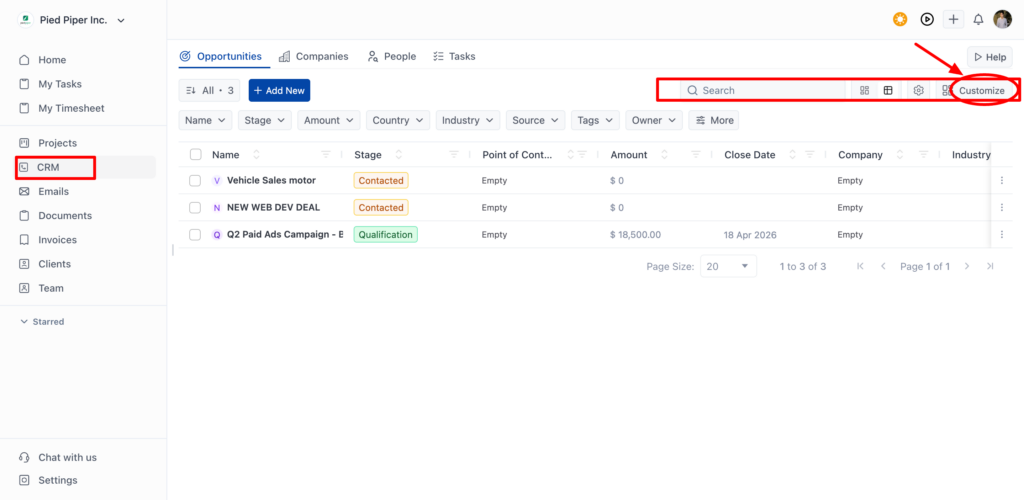
Customize
Click Customize in the top right of the Opportunities view to tailor CRM to how your business actually works. It opens a panel with five sections:
Tab Settings
Tab Settings controls which sections appear in your CRM navigation. All four are turned on by default:
- Opportunities – Your sales pipeline. Leave this on.
- Companies – Your organization database.
- People – Your contact database.
- Tasks – All CRM-related tasks in one place.
Industry
Manage the list of industries available when categorizing companies and opportunities. Add, edit, or remove options to match your market.
Source
Define where your leads come from. Add your own source options — referral, inbound, cold outreach, social media, whatever fits your sales process.
- Email Campaign – Leads that came in through an email marketing campaign
- SEO – Prospects who found you through organic search
- LinkedIn – Connections and outreach from LinkedIn
- Event – Leads you met at a conference, webinar, or any live event
- Referral – Deals sent your way by an existing client or partner
- Website – Inbound inquiries through your website
Tag
Create and manage tags for organizing opportunities. Tags let you group and filter deals by anything that doesn’t fit a standard field.
Adding a Tag
Type a name in the Tag name field and click + Add Tag. That’s it. The tag is now available to apply to any opportunity.
Opportunity Automation – Set up automated actions that trigger as deals move through your pipeline. Move a deal to a new stage and let OneSuite handle the follow-up steps automatically.
Opportunity Automation
Opportunity Automation reduces manual work by creating opportunities for you automatically. One setting, one naming format, and CRM starts building your pipeline without the extra steps.
Auto-create Opportunity
This toggle is on by default. When enabled, OneSuite automatically creates a new opportunity whenever a new company or contact enters your CRM. You don’t have to remember to create it manually — it’s already there waiting.
Turn it off if you prefer to create opportunities yourself, one by one, only when there’s a real deal to track.
Opportunity Name Format
Control how auto-created opportunities get named. Two fields let you wrap the company name with your own text:
- Prefix – Text that appears before the company name. For example, Deal – produces Deal – Company Name
- Suffix – Text that appears after the company name. For example, – New produces Company Name – New
What You Can Do in CRM
Track deals through stages – Move opportunities as they progress through your sales process.
Manage relationships – Store complete company and contact information in one place.
Assign ownership – Clarify who’s responsible for each opportunity, company, or person.
Set tasks and reminders – Create follow-ups on any record with due dates.
Customize for your business – Add custom fields for budget range, project type, referral source, or anything else you track.
Import existing data – Bring in contacts and companies from spreadsheets. Move up to 1,000 records at once.
Search and filter – Find exactly what you need across all your CRM data.
Convert to clients – Click Convert to Client when you win a deal. All history stays intact.
Three Ways to View Your Data
Kanban View (Opportunities only) – Visual pipeline with drag-and-drop cards organized by stage. See forecasted revenue per stage. Switch between expanded view (full details) and compact view (more cards on screen).
List View (All record types) – Traditional table with sortable, filterable columns. Customize which columns appear.
Detail View (All records) – Click any record to see complete information. Tabs organize Timeline, Tasks, Files, and Emails.
Getting Started with CRM
If you’re setting up CRM for the first time:
- Add a few companies and people you’re actively talking with
- Create opportunities for current sales conversations
- Link each opportunity to the right company and person
- Move deals through stages as they progress
Start small with real work. Get comfortable with active deals before importing historical data.
Related Articles
- How Opportunities, Companies, and People Work Together (coming next)
- Understanding OneSuite’s Structure
- How Solutions Work Together
- OneSuite Glossary