
Skip to content
OneSuite Logo
  • SolutionsExpand
    • Client Portal

      Ensure transparency & gain trust

      Invoice

      Create invoices in minutes & get paid

      Project Management

      Manage tasks smartly & deliver timely

      CRM

      Nurture leads and win more clients

      Document & E-Signature

      Create & sign documents easily

      Team & Collaborators

      Work together, stay aligned

      Email Inbox

      Manage client emails in one place

      Time Tracking

      Track hours and boost productivity

      Productized Service

      Package and sell services easily

  • Use CasesExpand
    • Marketing Agency

      Manage campaigns, clients, and billing in one place so you can focus on delivering results.

      SEO Agency

      Track projects, share reports, and invoice clients without juggling five different tools.

      Video Editing

      Streamline approvals, revisions, and payments so you spend more time in the timeline.

      Local SEO

      Organize multi-location clients, automate invoicing, and keep every project on track.

      Photography

      From booking to final delivery, manage your entire client workflow in a single dashboard.

      Event Management

      Coordinate timelines, vendors, and client communications without anything slipping through the cracks.

      Creative Agency

      One workspace for briefs, feedback, and billing so your creative energy stays on the work.

      Consulting

      Proposals, project tracking, and invoicing unified so you look as professional as your advice.

      IT Services

      Manage tickets, retainers, and client portals without duct-taping a dozen SaaS tools together.

  • ResourcesExpand
    • Documentation

      Read guides and help docs

      Affiliate

      Partner and earn together

      Integrations

      Connect tools effortlessly

      Roadmap

      See what’s coming next

      Changelog

      Stay updated with the latest

      Support

      Get help whenever you need it

      Compare

      See how OneSuite stacks up

      Case Study

      Real results, real teams

      FAQ

      Find answers to common questions

  • Pricing
  • For Agency

Start free trial

Help Center

  • Documentation
  • Public Roadmap
  • Book a demo
  • Get Support
OneSuite Logo
intro to onesuite

OneSuite 101

6
  • Introduction
  • Understanding OneSuite’s Structure
  • How Solutions Work Together
  • Navigating OneSuite
  • All OneSuite Capabilities
  • OneSuite Glossary
quick start guide

Quick Start Guide

7
  • Setting Up Your Business
  • Adding Your Payment Methods
  • Inviting Team Members
  • Adding Your First Leads
  • Adding Your First Client
  • Giving Your Client Portal Access
  • Sending Your First Proposal

CRM

7
  • Customizing Your Opportunities View
  • CRM Overview
  • Adding People
  • Adding Companies
  • Creating Opportunity
  • How Opportunities, Companies, and People Work Together
  • Understanding Pipeline Stages
client

Client Management in OneSuite

7
  • Adding Clients
  • Client Profiles
  • Client Portal Customization 
  • Understanding the Clients Solution
  • Imports, Exports, and Search
  • The OneSuite Client Portal
  • Video Documentation : Client Management
pm

Manage your Projects Effortlessly

7
  • Subtask Behavior & Movement Management
  • Laying the Groundwork: Project Creation in OneSuite
  • Managing Project Boards in OneSuite
  • Adding Tasks to Boards in OneSuite
  • Lifesaver:Templates in OneSuite
  • Custom Categories, Tags, and Labels in Projects
  • Video Documentation : Project Management

Documents

5
  • Overview
  • Creating a Document from Scratch
  • Uploading a PDF Document
  • Sending Documents to Parties to Sign
  • Signing a Document
team

OneSuite's Team Management

4
  • Inviting Collaborators in OneSuite
  • Creating Personalized Departments in OneSuite
  • Managing Team Members in OneSuite
  • Video Documentation : Team Collaboration
Invoices & Payments

Invoices & Payments

7
  • Access & Navigation
  • Invoice Settings & Customization
  • Create One-time Invoices
  • Creating Recurring Invoices
  • How to set taxes on your invoices
  • How to Add Direct Bank Transfer Instructions to Your Invoices
  • How to Customize Invoice Email Messages

Time Tracking & Timesheets

4
  • Invoice Generation from Billable Hours
  • Timesheet Management & Approval
  • Time Tracking in OneSuite
  • Time Tracking & Timesheets 

Email Inbox in OneSuite

5
  • Gmail and Outlook integration
  • How to Integrate Microsoft Outlook in OneSuite 
  • How to Use Email Templates in OneSuite 
  • How to Integrate Gmail in OneSuite 
  • How to Send and Receive Email in OneSuite 

Calendar View

1
  • Calendar View

Dashboard

7
  • Overview 
  • How to Customize Your Dashboard
  • Client Portal Dashboard 
  • Monitor Documents, Contracts & Marketing Lead Sources
  • CRM, Client & Pipeline Widgets — OneSuite Dashboard Guide
  • Track Tasks, Deadlines & Project Activity in OneSuite
  • Track Revenue Trends, Forecasts & Top Projects in OneSuite
View Categories
  • Home
  • Docs
  • CRM
  • How Opportunities, Companies, and People Work Together

How Opportunities, Companies, and People Work Together

The CRM solution uses three record types that connect automatically. Understanding how opportunities, companies, and people link together helps you track relationships and sales progress without duplicate data entry.

In this guide you’ll learn:

  • What each record type stores
  • How the three types can work together
  • When you need companies vs. when people alone work fine
  • The standard B2B agency scenario
  • How conversion to clients works differently based on structure

The Three Record Types #

Opportunities #

An opportunity represents a specific sales deal you’re pursuing. It’s not just a contact or a company – it’s an actual potential project with revenue attached.

What opportunities store:

  • Deal name (e.g., “Website Redesign – BlueSky Marketing”)
  • Amount (dollar value of the deal)
  • Stage (where it is in your sales process)
  • Close date (when you expect to win or lose)
  • Owner (team member responsible)
  • Custom fields specific to your sales process

When to create an opportunity: You have a specific conversation about paid work. Not just “they might need something someday” but “we’re discussing this actual project.”

Example: Jessica Moore from Brightwave Fitness reaches out about redesigning their mobile app. That’s an opportunity – a specific project worth $48,000.
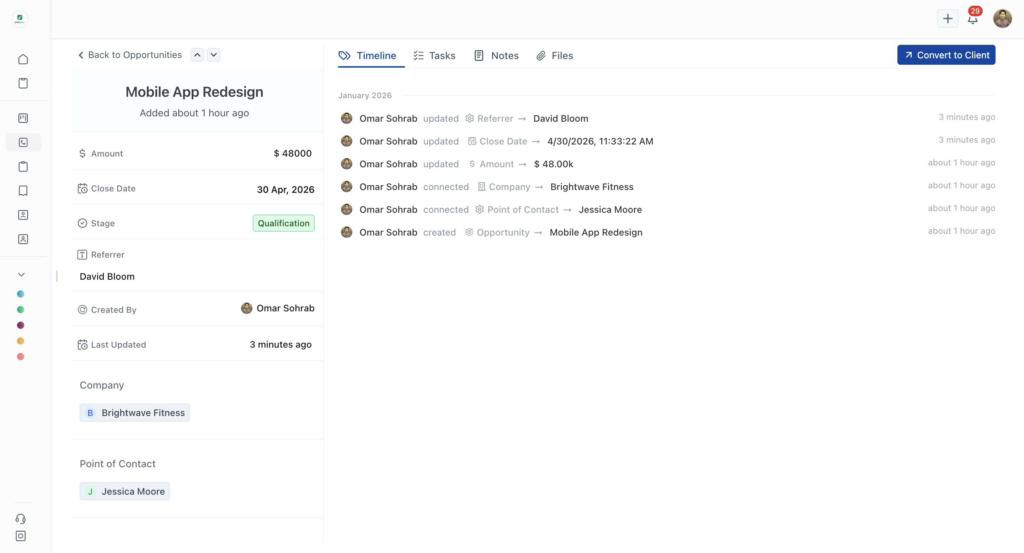
Jessica Moore from Brightwave Fitness reaches out about redesigning their mobile app. That's an opportunity - a specific project worth $48,000.

Companies #

mpany is an organization you’re working with or pursuing. It stores business-level information that doesn’t change with individual deals.

What companies store:

  • Company name and domain
  • Industry and source
  • Multiple email addresses and phone numbers
  • Annual recurring revenue (ARR)
  • Employee count
  • Whether they match your ideal customer profile (ICP)
  • Custom fields for company-level data

When to create a company: You’re working with or pursuing an organization (not a solo individual). Even if you only know one person there, create the company record if they work for a business.

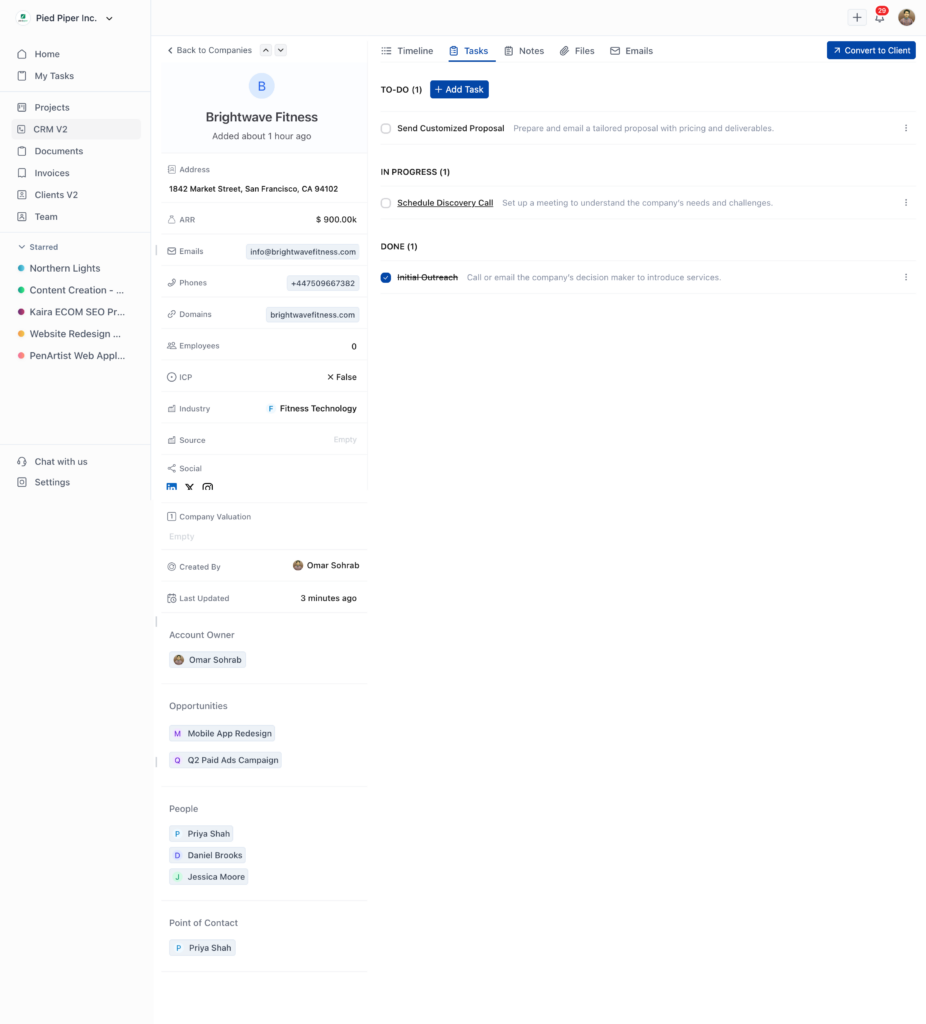
Example: Brightwave Fitness is a company in the Fitness Technology industry. They have multiple people working there and multiple projects in progress.
People #

People are individual contacts. These are the actual humans you email, call, and meet with.

What people store:

  • Name and job title
  • Email addresses and phone numbers
  • Social media profiles (LinkedIn, Twitter, etc.)
  • Physical address
  • Which company they work for (if any)
  • Custom fields for contact-level data

When to create a person: You have an individual contact. They might work at a company or be a solo freelancer. Either way, you need their personal contact information.

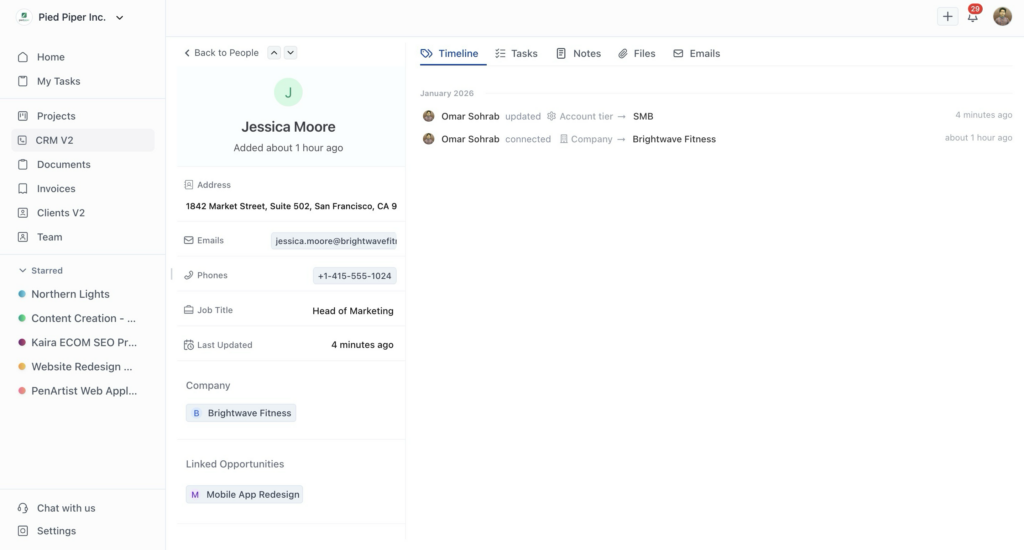
Example: Jessica Moore is the Head of Marketing at Brightwave Fitness. She’s a person record linked to the Brightwave Fitness company.
Two Ways to Structure Your CRM #

You don’t always need all three record types. OneSuite is flexible based on who you’re working with.

Scenario 1: Working with Solo Professionals #

When: You’re working with freelancers, consultants, or individual service providers.

What you create:

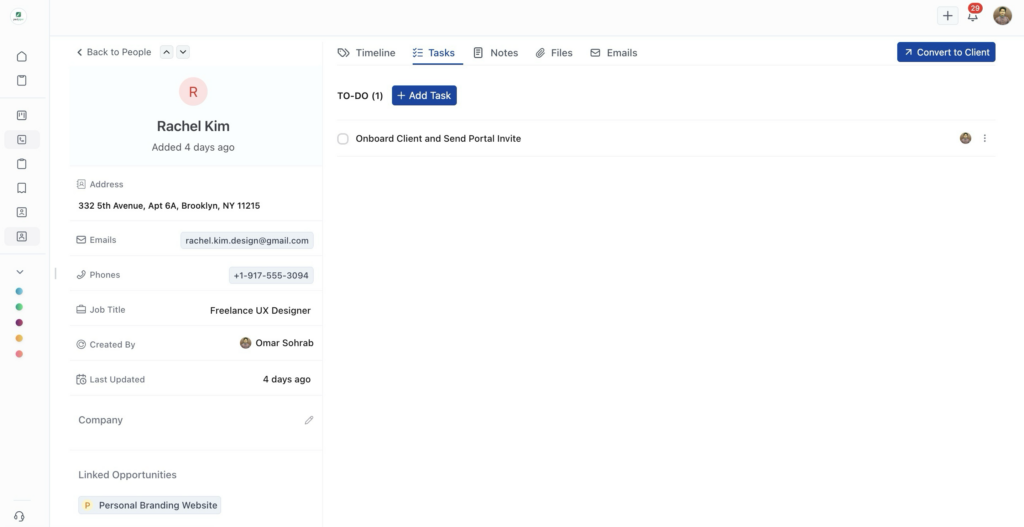
  1. Person – Rachel Kim, Freelance UX Designer
  2. Opportunity – “Website UX Redesign” for $8,500
  3. Link the opportunity to Rachel as point of contact

No company needed. Rachel is the business. When you convert this opportunity to a client, it becomes an Individual client.
Scenario 2: Working with Businesses (Standard B2B) #

When: You’re working with companies that have multiple employees.

What you create:

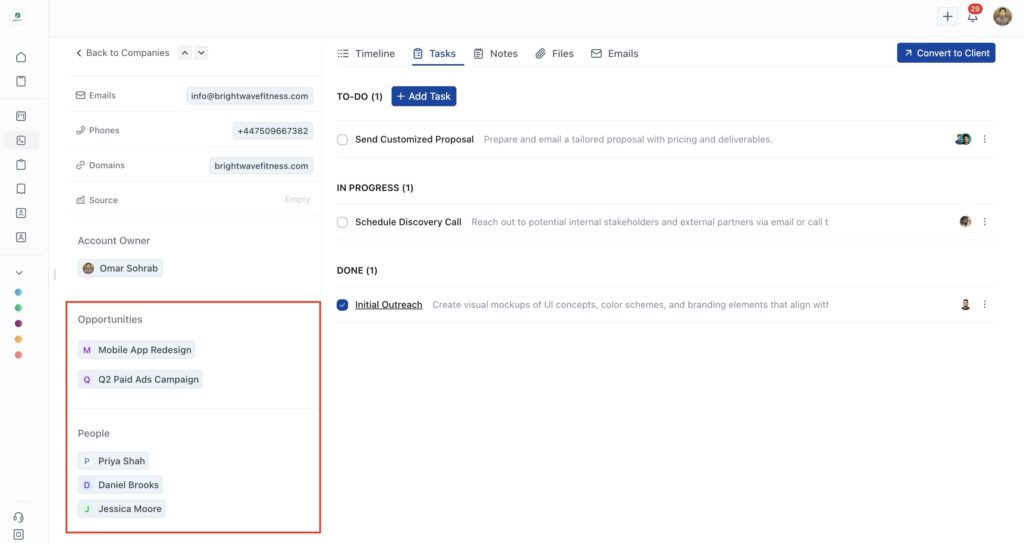
  1. Company – Brightwave Fitness
  2. People – Priya Shah (Product Manager), Daniel Brooks (CEO), Jessica Moore (Head of Marketing)
  3. Opportunities – “Q2 Paid Ads Campaign” with Priya as point of contact, “Mobile App Redesign” with Jessica as point of contact

This is the standard agency scenario. Businesses have multiple employees. You might work with different people on different projects, but they all work for the same company. When you convert an opportunity to a client, it becomes a Company client.

The Standard B2B Agency Scenario

Most agencies work business-to-business. Here’s how the structure typically works:

Company: Brightwave Fitness #

A fitness technology company. They’re one organization with multiple employees.

Multiple Employees: #

  • Priya Shah – Product Manager
  • Daniel Brooks – CEO
  • Jessica Moore – Head of Marketing

Multiple Projects: #

  • Q2 Paid Ads Campaign ($18,500) – Point of contact: Priya Shah
  • Mobile App Redesign ($48,000) – Point of contact: Jessica Moore
Why This Structure Matters: #

Track the relationship, not just the deal. You’re building a relationship with Brightwave Fitness (the company), not just with individual people. Today you work with Priya. Next month you might work with Daniel on something different.

See the complete picture. When you open Brightwave Fitness, you see all contacts, all opportunities, all history. You understand the full relationship.

Avoid duplicate outreach. When Priya and Jessica both work at Brightwave, you know it. You don’t accidentally pitch the same service twice.

Forecast accurately. The Q2 Ads Campaign and App Redesign are separate deals with separate stages and values, but they both contribute to your relationship value with Brightwave.

How Linking Works

Standard B2B Linking #

Company: Brightwave Fitness
   ↓
People: Priya Shah, Daniel Brooks, Jessica Moore
   ↓
Opportunity 1: Q2 Paid Ads Campaign → Point of contact: Priya
Opportunity 2: Mobile App Redesign → Point of contact: Jessica

Each opportunity links to the company and designates which person is the point of contact for that specific deal.

Solo Professional Linking #

Person: Rachel Kim (Freelance UX Designer)
   ↓
Opportunity: Website UX Redesign → Point of contact: Rachel

No company. The opportunity links directly to the person.

Point of Contact Explained

Every opportunity needs a point of contact – the specific person you’re communicating with about that deal.

In the B2B Scenario: #

Brightwave Fitness has three employees in your CRM. You’re working on two projects:

  • Q2 Ads Campaign uses Priya as point of contact (she’s managing the marketing initiative)
  • Mobile App Redesign uses Jessica as point of contact (she’s leading the app project)

Same company. Different contacts. That’s normal. Companies have different people handling different initiatives.

In the Solo Professional Scenario: #

Rachel Kim is working with you on a website redesign. Rachel is the point of contact. There’s nobody else to contact – she’s the business.

Common Questions #

Can I add a company later?

Yes. Start with a person, add the company when you learn they work for one.

Can I have a company with no people?

Yes. Add people as you identify contacts.

Do I need to fill in all company fields?

No. Company name is required. Add other details as you learn them.

Can someone work at two companies?

Each person links to one company. This covers most real-world scenarios.

Can I convert multiple opportunities separately?

Yes. Win the Ads Campaign but lose the App Redesign? Convert only what you won.


Updated on January 30, 2026

Did this article answer your question?

  • Happy
  • Sad
Creating OpportunityUnderstanding Pipeline Stages

Leave a Reply Cancel reply

Your email address will not be published. Required fields are marked *

This site uses Akismet to reduce spam. Learn how your comment data is processed.

Table of Contents
  • The Three Record Types
    • Opportunities
    • Companies
    • People
  • Two Ways to Structure Your CRM
    • Scenario 1: Working with Solo Professionals
    • Scenario 2: Working with Businesses (Standard B2B)
    • Company: Brightwave Fitness
    • Multiple Employees:
    • Multiple Projects:
    • Why This Structure Matters:
    • Standard B2B Linking
    • Solo Professional Linking
    • In the B2B Scenario:
    • In the Solo Professional Scenario:
  • Common Questions
OneSuite Logo

Streamline your agency's workflow while you focus on growth—manage clients, projects, teams, proposals, contracts, and invoices effortlessly with OneSuite!

product hunt

Follow Us On

  • Facebook
  • X
  • Instagram
  • LinkedIn

Join Our Community

  • Facebook
  • WhatsApp

Features

Projects

Lead Pipeline

Documents

Invoices

Client Portal

Teams

Resources

Contact

Support

Docs

Blog

Branding

Become an affiliate

Agency Partner Program

Public roadmap

Book a demo

Compare

OneSuite vs. Kitchen Co

OneSuite vs. Moxie

OneSuite vs. Flowlu

OneSuite vs. Plutio

OneSuite vs. Bonsai

OneSuite vs. ClientManager

  • Terms of use
  • Privacy policy
  • Cookie policy
  • Refund policy
  • Acceptable use policy
  • Data processing terms
  • Solutions
    • Client Portal

      Ensure transparency & gain trust

      Invoice

      Create invoices in minutes & get paid

      Project Management

      Manage tasks smartly & deliver timely

      CRM

      Nurture leads and win more clients

      Document & E-Signature

      Create & sign documents easily

      Team & Collaborators

      Work together, stay aligned

      Email Inbox

      Manage client emails in one place

      Time Tracking

      Track hours and boost productivity

      Productized Service

      Package and sell services easily

  • Use Cases
    • Marketing Agency

      Manage campaigns, clients, and billing in one place so you can focus on delivering results.

      SEO Agency

      Track projects, share reports, and invoice clients without juggling five different tools.

      Video Editing

      Streamline approvals, revisions, and payments so you spend more time in the timeline.

      Local SEO

      Organize multi-location clients, automate invoicing, and keep every project on track.

      Photography

      From booking to final delivery, manage your entire client workflow in a single dashboard.

      Event Management

      Coordinate timelines, vendors, and client communications without anything slipping through the cracks.

      Creative Agency

      One workspace for briefs, feedback, and billing so your creative energy stays on the work.

      Consulting

      Proposals, project tracking, and invoicing unified so you look as professional as your advice.

      IT Services

      Manage tickets, retainers, and client portals without duct-taping a dozen SaaS tools together.

  • Resources
    • Documentation

      Read guides and help docs

      Affiliate

      Partner and earn together

      Integrations

      Connect tools effortlessly

      Roadmap

      See what’s coming next

      Changelog

      Stay updated with the latest

      Support

      Get help whenever you need it

      Compare

      See how OneSuite stacks up

      Case Study

      Real results, real teams

      FAQ

      Find answers to common questions

  • Pricing
  • For Agency
  • Documentation
  • Public Roadmap
  • Book a demo
  • Get Support